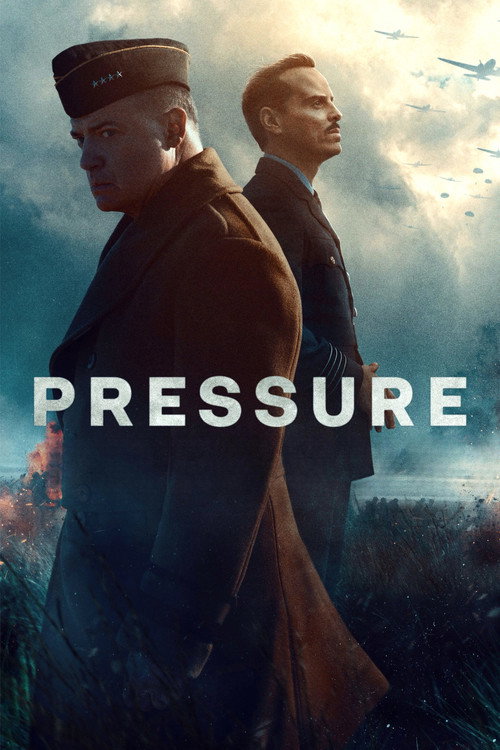
Pressure (2026) is a Tense Study of Leadership Under Duress
Pressure is a compelling historical thriller that succeeds by anchoring its massive, world-altering stakes in the claustrophobic anxiety of a single meteorological office. It is worth watching for anyone who enjoys the psychological friction of wartime decision-making over the spectacle of battlefield combat.
A War Won by Barometers
The film effectively transforms the mundane act of weather forecasting into a high-stakes thriller, focusing on the friction between James Stagg’s cautious data-driven approach and the aggressive optimism of his peers. By centering the story on the 72 hours leading up to D-Day, the narrative creates a natural, ticking-clock momentum that feels earned rather than manufactured.
While the mainstream view might focus on the military might of the invasion, the film correctly identifies that the true conflict resides in the silence of a command room. The cinematography by Jamie D. Ramsay excels here, using tight framing to emphasize the isolation of the men tasked with predicting a storm that could doom thousands of soldiers.
The Weight of Command
Brendan Fraser delivers a nuanced performance as Dwight Eisenhower, capturing the exhaustion of a leader who must weigh cold, hard statistics against the human cost of waiting. His interactions with Andrew Scott’s Stagg serve as the emotional core of the film, highlighting the friction between political necessity and scientific integrity.
However, the script occasionally leans too heavily into the melodrama of the weather predictions, briefly losing the gritty realism that makes the first act so gripping. Those who enjoy historical dramas that prioritize character dynamics over action sequences will find this rewarding, while viewers seeking a traditional, fast-paced war film may find the dialogue-heavy sequences frustratingly slow.
The Burden of Certainty
The technical craft, particularly Volker Bertelmann’s score, does an excellent job of mirroring the volatility of the weather systems being tracked. It heightens the sense of impending doom without resorting to conventional war-movie tropes, allowing the audience to feel the same pressure as the meteorologists.
The film is a must for history buffs who appreciate the granular details of logistical planning during World War II. Conversely, if you are looking for a sprawling, multi-perspective epic that covers the breadth of the invasion, you should skip this, as it remains firmly planted within the confines of the Allied command center.
Pressure: Ending Explained
(Spoilers ahead) The conclusion of the film highlights that the ultimate victory of D-Day was not a result of military genius alone, but of the terrifying courage required to trust an incomplete forecast. By choosing to launch the invasion despite the volatility of the weather, Eisenhower and Stagg accept a reality where there is no “correct” answer, only the consequences of a gamble.
This ending delivers as a stark reflection on the nature of war, suggesting that even the most pivotal moments in history are often decided by fallible men staring at charts rather than maps. The resolution reinforces the theme that leadership is not about having all the answers, but about having the resolve to act when the data is screaming for caution.