A Family’s Move to Norway Puts Its Beliefs on Trial
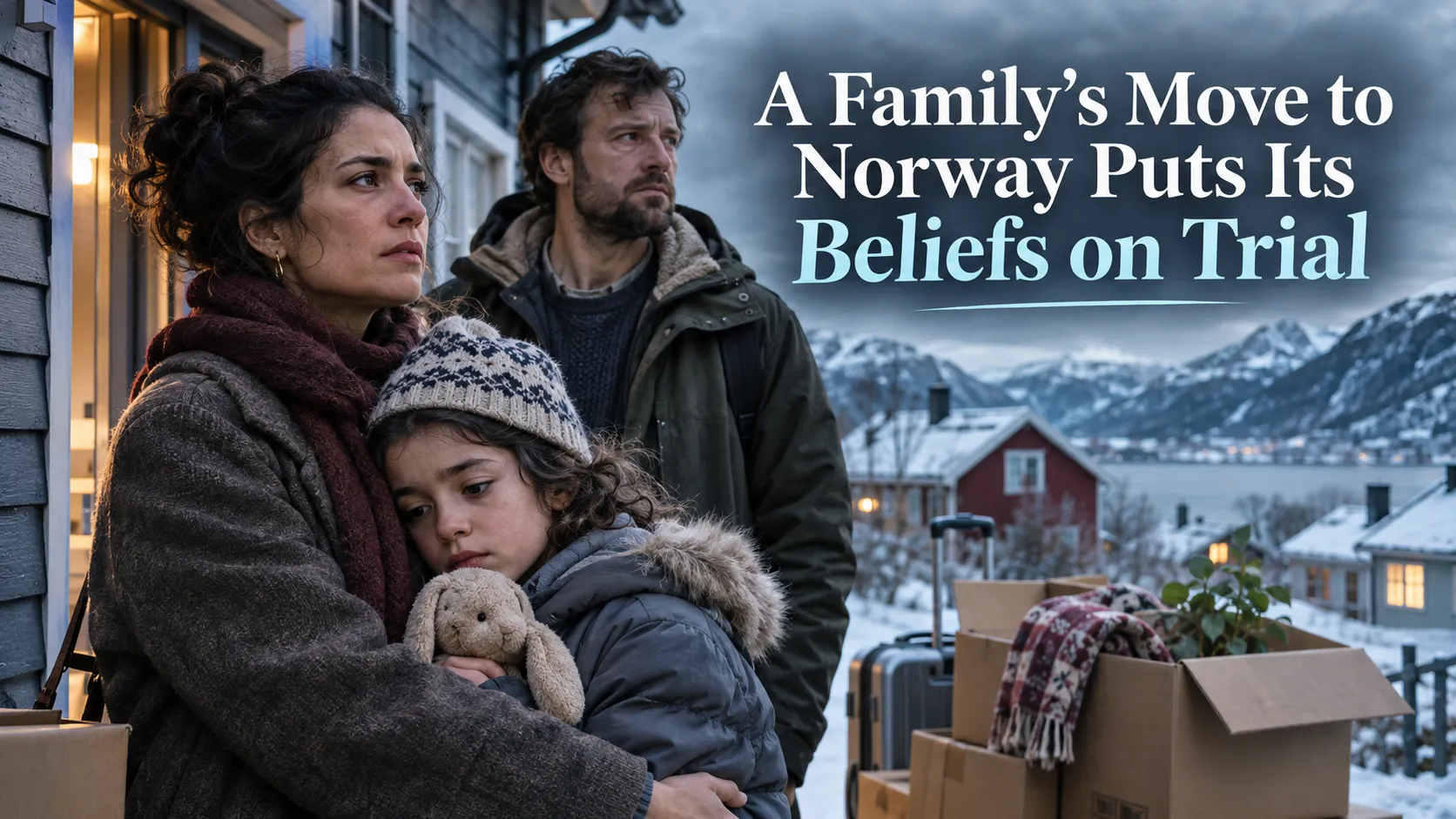
A family’s attempt to begin a new life causes a moral quandary in the filmmaker Cristian Mungiu’s 2026 drama, Fjord.
Starring Sebastian Stan and Renate Reinsve, the movie follows a traditional Romanian-Norwegian family who moves with their children to a remote community in Norway.
Due to the family’s unusual beliefs and practices, the neighbors soon begin to take notice and increasingly become worried.
It soon comes to the attention of the school that a child has been abused, and the question of the family’s belief system and the rights of the state to protect children becomes a growing moral dilemma.
The film’s competitive premiere at the 2026 Cannes Film Festival with the Palme D’Or solidified Mungiu’s next movie as one of the most anticipated international dramas of the year.
What Is Fjord About?
The plot follows a religious family, the Gheorghius, who moves from Romania to Norway.
Lisbet, the mother, has family ties to the remote community.
Once there, they hope to build a better life and to reconnect with their relatives.
In the beginning, the family befriends the neighboring Halbergs. The kids become friends despite having different upbringings.
The Gheorghius teenage daughter Elia begins developing a relationship with the Halberg son.
Things get even more morally complicated when Elia’s father discovers bruises on her body.
Authorities become involved, and the father is accused of child abuse.
The family has to face the standards of a community whose social values don’t match with theirs.
This is a conflict the film shows without resolving every question in a simple way.
Sebastian Stan and Renate Reinsve star in the film.
Stan is Mihai Gheorghiu, a Romanian father, whose religious believes mark his way of being a father, in the movie. Including this role, Stan has been seen in The Apprentice (2016) and A Different Man (2021). Aspects of both art works are related to the subject of this novel.
Reinsve plays Lisbet, Mihai’s Norwegian wife, with whom he has two daughters. She is taking care of the family business while her husband is dealing with the things related to his work. During weekends they attend church together and go hiking.
Having different traditions than the ones in the rest of the country, the family feels the pressure of adapting to a different belief system and an environment that is questioned by their own belief systems.
Those things make Fjord a good option for viewers interested in discovering more about Norwegian Cinema.
Mungiu’s latest film explores an challenging moral dilemma.
Mungiu wrote and directed the film. He has a strong place in contemporary Romanian cinema as an author who is able to deal with morally complicated situations in an realistic manner. Fjord is his fifth feature length fiction film after Beyond the Hills (2012), Graduation (2016) and R.M.N. (2019).
Mungiu won his first Palme d’Or in 2007 for 4 Months, 3 Weeks and 2 Days and Fjord allowed him win it again.
The filmmaker looks at the effect institutions have on people in challenging situations.
This film looks at family, school, social services, and the legal system.
The film suggests that there are institutional consequences for social services’ inability to protect children and the challenges of assessing family practices across cultural boundaries.
There are also ways that social structures and family practices can clash and lead to individuals holding deeply-rooted convictions that conflict with social structures and family practices.
Religion and Parenting
A big part of the film looks at how child welfare and religious freedoms intersect.
The Gheorghius family is part of a conservative Christian community where their beliefs influence their family life.
Elsewhere in the film, Norwegian ideas about discipline and independence clash with parental practices.
These beliefs come to a head when Elia is concerned about bruises and social services become involved.
The adults on both sides have to advocate and defend their practices.
The film asks how, when dealing with cultural differences, institutions should balance practices that seem extreme.
There are also ways that individual practices clash with deeply-rooted family and social convictions.
The film suggests that suspicion, prejudice, and presumptions can lead to individuals reaching different conclusions about the same set of practices.
Mungiu asks what the consequences are for not acting when child welfare is concerned and suggests that people shouldn’t lessen the impact of child welfare concerns when thinking about what responsibilities people should carry for child welfare practices.
Fjord premiered in 2026 at the Cannes Film Festival, where it won the Palme d’Or.
It was also critically acclaimed at the film festivals it played at after Cannes.
Running at 146-minutes, this gives the film time to examine the breakdown of the relationships of the various families and their connection with the community.
The production brings together a team from Romania, France, Norway, Sweden, Denmark and Finland.
The cinematographer is Tudor Vladimir Panduru and the music is by Kaspar Kaae.
The location uses the imposing landscape of western Norway to show the family’s isolation.
Search terms like Pikashow TV APK download suggest the film is not available in a legal capacity.
The availability will be determined by the local distributors.
The film had its premiere at the Cannes Film Festival. Fjord opened in French cinemas on the 19th August 2026. NEON released the film in the U.S. on the 9th October 2026. The Brazilian distributor Diamond Films set the release for the 4th February 2027. The film also is Romania’s entry for the 2027 Academy Awards for Best International Feature Film. The film shows the urgency for Mungiu to return to the emotionally charged moral dilemmas that first brought international attention to his work with films such as “West Side”. Using a variety of visual and aural elements, Mungiu analyses the family dealing with cultural displacement and responsibilities. The audience comes to no easy conclusions. Rather the film presents an opportunity for the audience to explore conflicts that arise when confronted with their values and beliefs and dealing with children.