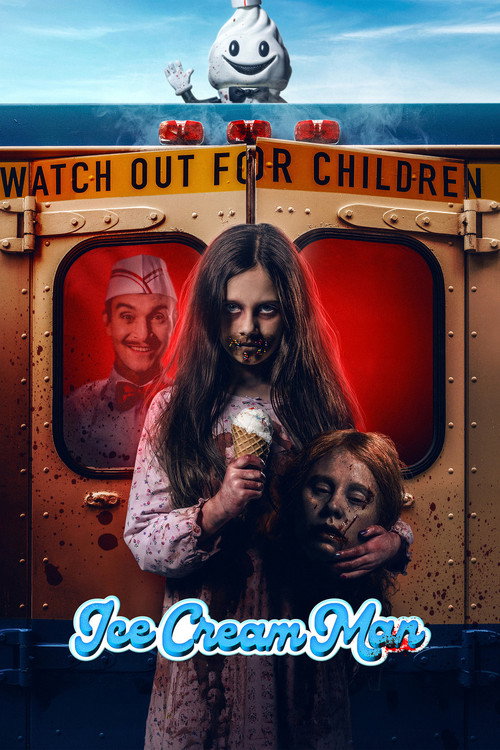
A Frozen Failure: Why Ice Cream Man Is Best Left Melting
Eli Roth’s horror movie Ice Cream Man (2026) misses the mark on effectively capturing the feeling it aims for. Although the premise sounds like a fun small-town summer madness story, the movie is simply a mean-spirited film that lacks the structure and the execution to justify the film’s being.
A Derivative Descent Into Summer Dread
The movie tries to create a suburban nightmare using an example of a predatory ice cream man, but it does not come off as a vision for the overall movie, but rather a collection of random stylistic attempts. Other films within the same genre have had the ability to use summers and create a feeling of overwhelming dread, while this film tries to create a series of disconnected and overly violent scenes that do not create a meaningful story. Simon Shohet’s cinematography does not feel like it has a coherent tone, and goes from overly bright shots and dark murky shots that do not hide the lack of quality the film has.
What makes the film worse to watch is that it generates its own images. During important parts of the film, this choice creates an off putting, out of place mood. It is more of a case of the director deciding to not deal with the images and leaving it to software. It ultimately gives an abandon and empty feel to the film, making it easy to disregard after watching it, as it does not provide even the slightest hint of a human presence and is almost a film that could be lived without.
Misguided Tone and Narrative Emptiness
Child actors usually deliver great performances, but, in this case, a bad script and direction took away that opportunity from them by forcing them into unnatural behavior. For instance, there seems to be particular cruelty in the way the film depicts child characters and pushes them into aggressive, slasher-like behavior that seems more like an underdone afterthought than an earned behavioral shift, leaving the audience wondering what the motivation was. This ultimately leaves us with an experience that is more uncomfortable than frightening. More abstract than anything else, the film’s central premise of a town turning on itself leaves us no other choice than to view the complete lack of motivation as an abstract, unfinished idea. This film attempts a nihilistic, bleak tone but it is ultimately an unfinished product that fails to get creative by refraining from exercising the artistic license necessary to starkly distinguish the approach other then the tired attempt at a bleak tone. A complete absence of artistic or substantive value leaves us with the single option of focusing on the shock value and avoids the need to provide a balanced offering of something for us to contemplate and anything that might be construed as satire. Dark humor and comedy offend the senses and this film shows us that, by crossing the line from dark and repulsive into the genuinely repellent, there are no lines that will be drawn in the process.
Ice Cream Man: Ending Explained
(Spoilers ahead) The ending presents a depressing conclusion to the film’s apparent thematic void, indicating the decay of the town is total and permanent. The film interprets the final violent acts as the ice cream man’s influence and attempts to suggest a nihilistic perspective in which there is no such thing as a real safe space; the violence will come through the surface. Yet, without the film articulating what was at stake, the dead weight of the last scenes constitutes a bleak, undeserved epilogue to a narrative that never began.